Tarot basics
How to Read Tarot Cards: A Complete Beginner’s Guide
To read tarot cards, start with one question and draw one card. Look closely at the picture, check a traditional meaning, and connect the two in a sentence that answers your question. You can do your first reading with the guidebook open beside you.
In this article
How to do a one-card tarot reading in five steps
-
Ask a question you can act on. If your sketchbook has been sitting unopened for a month, try asking, “What would help me start drawing again this week?” Write it down. This question gives you a focus for your one-card tarot spread.
-
Shuffle and draw. Hold the deck face down. Slide small groups of cards from one hand into the other, then turn over the top card when you’re ready. For this exercise, turn the picture upright.
-
Describe what you see. What is the figure doing? Where are they looking? If your card shows objects or a landscape, notice a detail that repeats. Tarot author Mary K. Greer uses this kind of literal description in her single-card exercise.
-
Look up the card’s meaning. Choose one idea you can connect to a detail in the picture. If the guidebook offers six keywords, you can work with just one.
-
Answer your question. Write one sentence in your own words. Keep the date, card name, and original question beside it. Leave a line for what you notice when you come back to the reading.
A worked example with the Eight of Pentacles
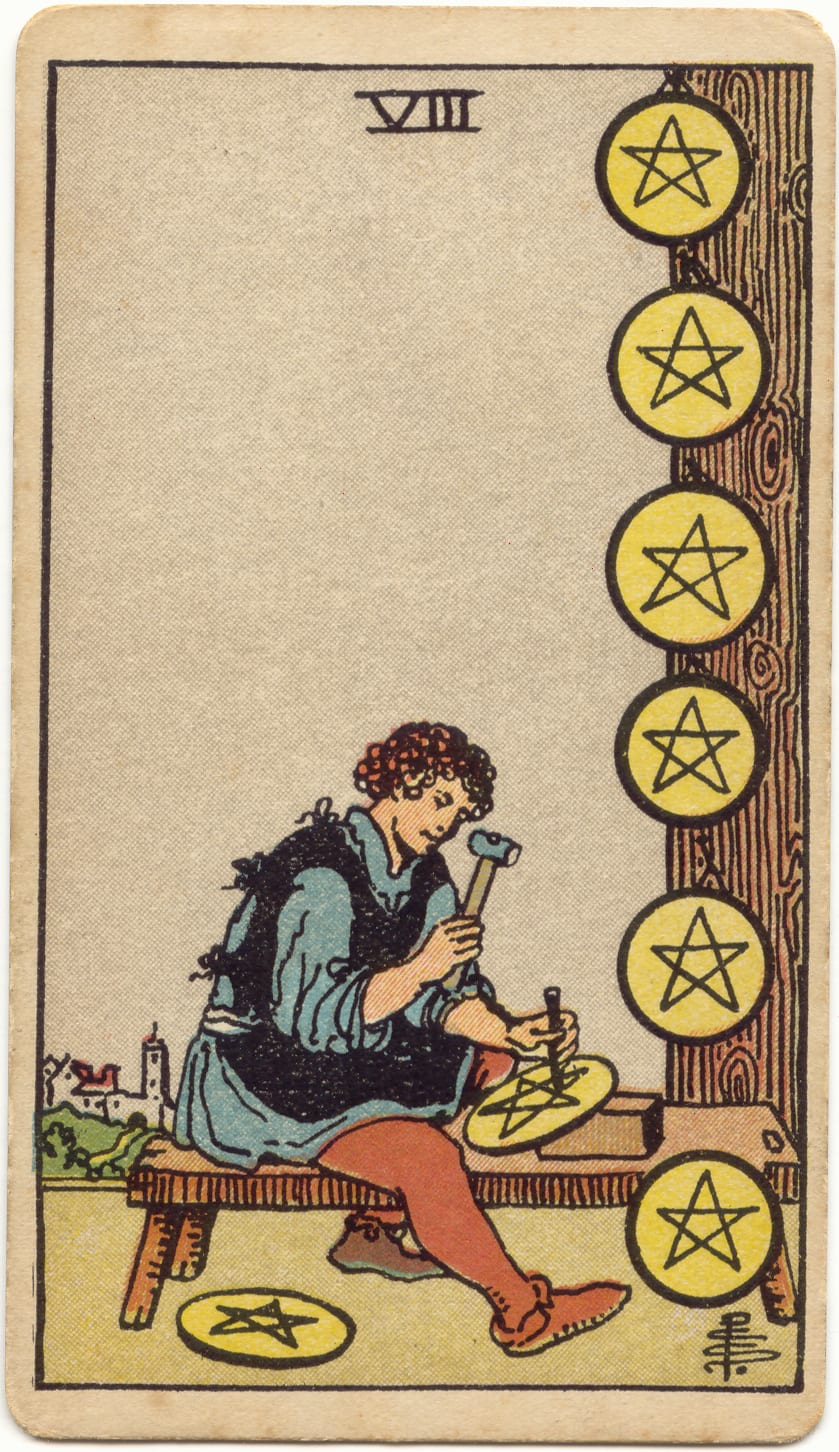
Suppose you draw the Eight of Pentacles for the sketchbook question. See if you can find all eight disks. Six run down the right edge. One lies on the ground. The eighth is under the chisel, right where the worker is looking.
Look at how often the worker has carved the same star. For someone returning to a sketchbook, the repeated shape suggests choosing one subject and giving it several tries. Arthur Edward Waite connects this card with craftsmanship in The Pictorial Key to the Tarot.
“At breakfast, I’ll draw the same coffee mug three times on one page.” Afterward, add a note to your reading. What did you see on the third drawing that you missed on the first?
How to read a Major Arcana card
When you draw a Major Arcana card, ask what larger theme it brings to your question. On Strength, a woman gently holds a lion’s jaws. Suppose you’re asking how to start drawing again. In the challenge position, Strength might prompt you to ask, “How quickly do I lose patience when a line comes out crooked?” In the advice position, that same gentle touch suggests an experiment. Leave the first sketch of your coffee mug on the page and draw another beside it.
What do the four tarot suits mean?
The 78-card Rider–Waite–Smith deck, illustrated by Pamela Colman Smith and first published in 1909, has 22 Major Arcana cards and 56 Minor Arcana cards in four suits. For the history of the deck and the distinction between the two groups, see What Is Tarot?
The table shows the elements commonly associated with the suits in modern Rider–Waite–Smith readings. These associations are described in the V&A’s guide to tarot cards.
| Suit | Element | Common themes | A question to try |
|---|---|---|---|
| Wands | Fire | Energy, creativity, initiative | What am I eager to start? |
| Cups | Water | Feelings, relationships, imagination | How do I feel about what happened? |
| Swords | Air | Thoughts, decisions, conflict | What do I need to say or clarify? |
| Pentacles | Earth | Work, money, practical skills | What can I practice with what I have? |
How to read the numbers on tarot cards
The numbered cards in each suit run from Ace to Ten. An Ace can suggest an opening. On the Ace of Wands, new leaves sprout from the staff. If you’ve been thinking about drawing, this could be the moment you see a shape you want to sketch.
A Two invites you to look at a pair. The Two of Pentacles shows one person juggling two disks. The Two of Cups shows two people facing each other, each holding a cup. In one picture the question might be how to balance two demands. In the other it might be what two people want to share.
Ten is the last numbered card. What has built up by this point? The rainbow on the Ten of Cups suggests shared happiness. The figure carrying ten staffs on the Ten of Wands suggests a load that has grown heavy. Compare the suits side by side in Joan Bunning’s guide to the numbered cards.
How to read Pages, Knights, Queens and Kings
Each suit also has four court cards. A court card can describe a person or suggest an approach you could take yourself. One way to try the ranks is to read a Page as exploring the suit, a Knight as pursuing it, a Queen as embodying its qualities, and a King as putting those qualities to work in the world. These distinctions draw on Bunning’s lesson on court cards.
Try the Page of Pentacles in the advice position. The Page holds up a single disk and studies it. For the sketchbook question, that might mean turning the mug in your hand and looking closely at the curve of its handle before you put pencil to paper.
To practice combining cards, place the Page beside the Eight of Pentacles. The Page studies the shape and the craftsperson works on it. Together they suggest a rhythm you can try at the table. Look once, draw once, then look again. You can compare their pictures in FlipTarot’s illustrated guide to all 78 cards.
How to read a three-card tarot spread
A spread is a layout that gives each card a role. Before you shuffle, choose three positions such as situation, challenge, and advice. Draw three cards from left to right. Here’s how the sketchbook question might look in this spread.
-
Situation
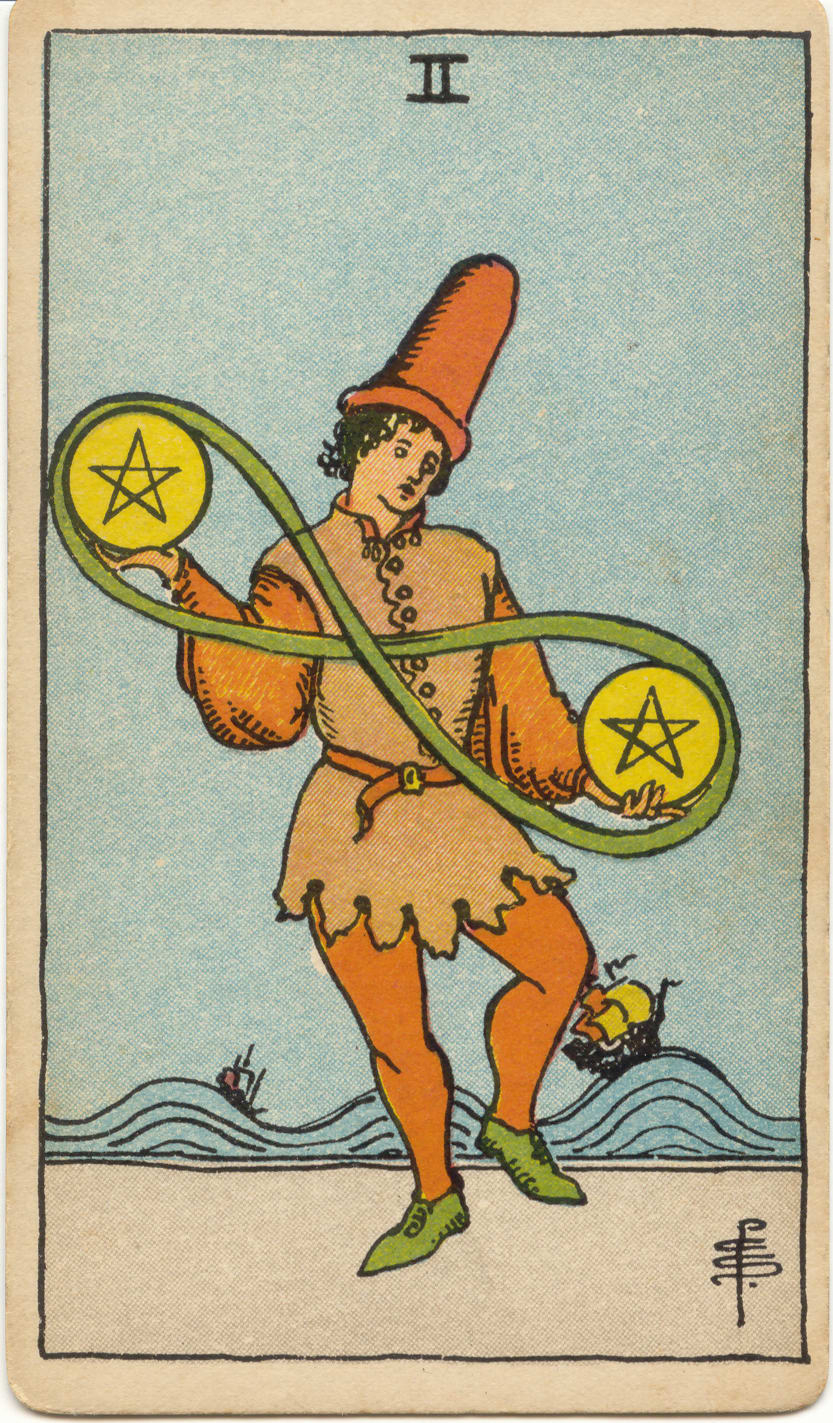
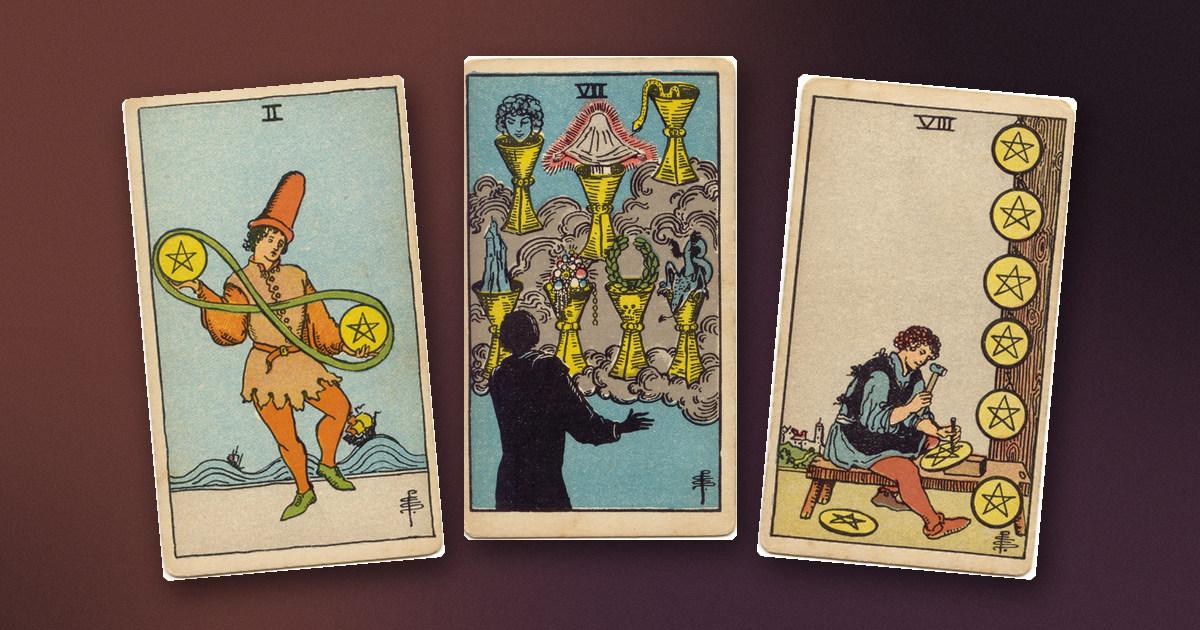
Two of Pentacles
The figure balances two disks as ships ride the waves. If your schedule keeps changing, where can you find ten quiet minutes?
-
Challenge
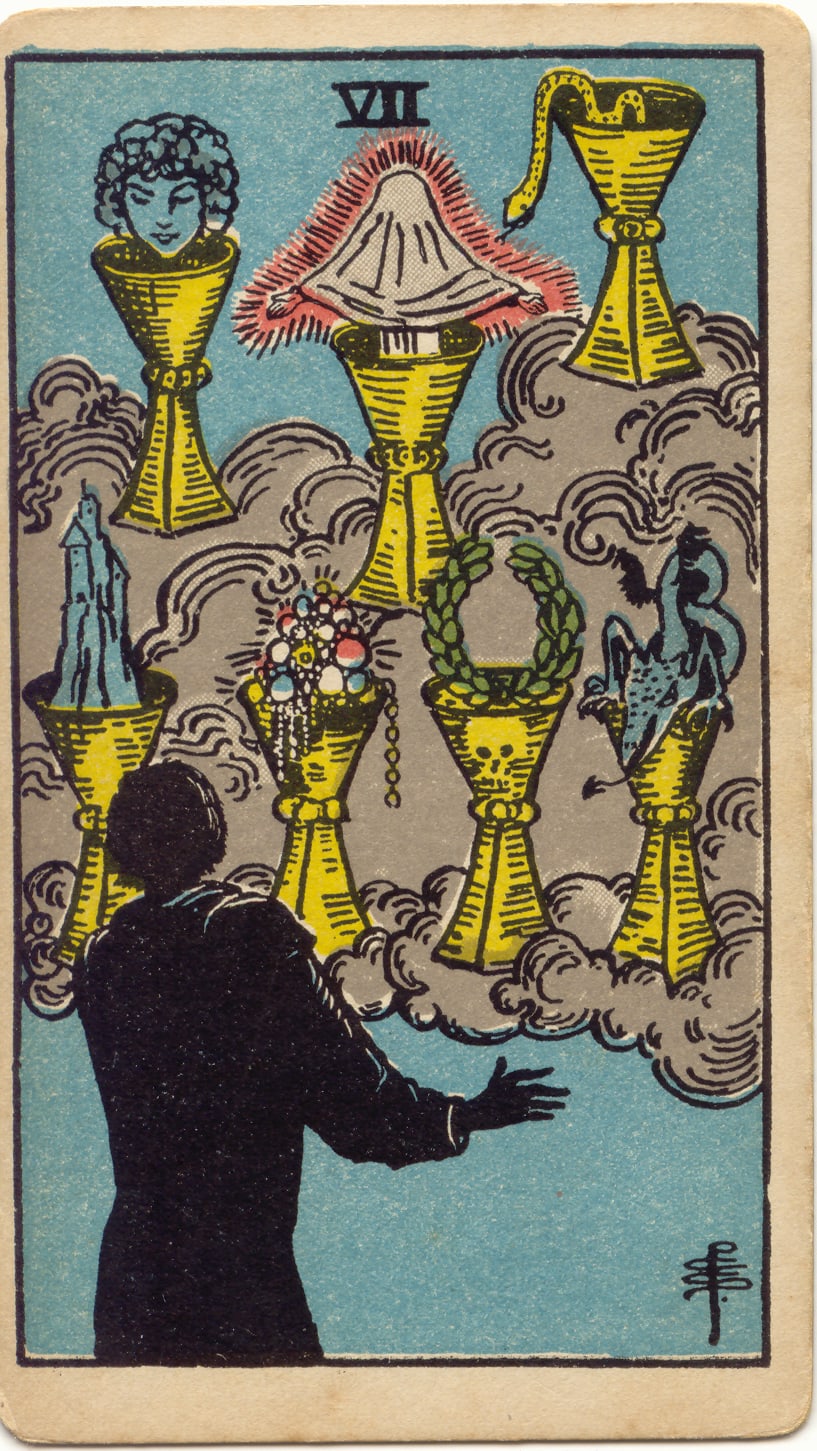
Seven of Cups
Seven cups hold seven possibilities. Perhaps you spend those ten minutes scrolling through saved drawing ideas, trying to choose one.
-
Advice
Eight of Pentacles
The worker sticks with one shape. Choose a subject tonight and leave it beside the sketchbook so you can begin tomorrow.
Pamela Colman Smith illustrated these cards. Saskia Jansen scanned them from her 1909 Roses & Lilies deck. Wikimedia Commons has the originals for the Two of Pentacles, Seven of Cups, and Eight of Pentacles.
How do the three cards work together?
Joan Bunning suggests thinking aloud as you look for the story across the cards, a technique she teaches in Learning the Tarot. Follow the figures’ hands as they juggle, reach, then settle on one task. You might say, “My free time comes in short stretches. If I choose what to draw tonight, I can use ten minutes to sketch tomorrow.”
Now move the Eight of Pentacles into the challenge position. The repeated star might bring up a different question. “Am I still redrawing the handle when I haven’t tried drawing the rest of the mug?”
For a question about how a situation is unfolding over time, assign the three cards different positions before you draw. One way to do that is the past, present, and future tarot spread.
Common questions about reading tarot cards
Do I need to memorize all 78 tarot cards before my first reading?
No. You can do your first reading with the guidebook open. Draw one card and name a detail you notice before you look it up. On the Eight of Pentacles, the worker is carving the same star you can see on the finished pieces. The next time you draw that card, those repeated stars may help you remember what practice looks like.
How long does it take to learn tarot?
You can do a first reading today. Reading fluently takes practice, and the pace varies. To notice your progress, draw one card a day for a week. At the end, return to the first card and see whether you can explain one detail in your own words before opening the guidebook.
Should beginners read reversed tarot cards?
Reversals are optional. Decide before you shuffle whether you’ll read cards that land upside down. If you do, start with the upright meaning. Is something getting in the way? Is it taking time to develop? Is it something you feel but haven’t expressed?
Take the Two of Pentacles. Upright, its juggler might suggest fitting a short sketch into a busy morning. Reversed, the same figure might remind you how often you try to do two things at once. What could wait ten minutes while you draw?
What if a card doesn’t seem to fit my question?
Look for a second detail. On the Two of Pentacles, the coins might make you think of money. Look again and you’ll see ships on rough water. If your question was about adjusting to a change, the waves may give you a way into the reading. If the connection still feels forced, write down what puzzled you and leave the question open.
Can I practice tarot without owning a deck?
Yes. Write down your question and open FlipTarot’s online tarot card draw. For your first reading, turn off Include reversals and draw a card. Before you look up its meaning, write down one detail you notice in the picture.