Tarot basics
What Is Tarot? A Guide to Its History, Cards, and Culture
In this article
Tarot is a system of illustrated cards used for divination, self-reflection, and exploring questions about life. A standard modern tarot deck contains 78 cards, divided into 22 Major Arcana and 56 Minor Arcana. People use these cards to explore relationships, consider choices, and bring a different perspective to a situation.
But understanding tarot involves more than learning what each card means. There are also the images themselves, the artists who created them, and the traditions that shaped how people read them.
A useful place to begin is with three questions: What is in the deck? What happens during a reading? And how did these cards become part of such a varied cultural tradition?
What Is in a Tarot Deck?
The Major Arcana: life’s larger themes
The 22 Major Arcana include cards such as The Fool, The Magician, The Lovers, The Hermit, Death, and The World. In the Rider–Waite–Smith tradition, they run from The Fool, numbered 0, to The World, numbered 21.
Modern readers often associate these cards with significant experiences, turning points, and broader life themes. One familiar way of understanding their sequence is the Fool’s Journey: a symbolic passage through experience toward greater awareness.
The Fool is commonly associated with beginnings and openness, The Hermit with reflection and inner guidance, and The World with completion and integration. Together, these images offer a way to think about a new beginning, a period of uncertainty, or the completion of a long effort as part of a larger story.
The Minor Arcana: everyday experiences
The 56 Minor Arcana are divided into four suits. Each suit contains ten numbered cards, from Ace through Ten, and four court cards: Page, Knight, Queen, and King. The court cards belong to the Minor Arcana rather than forming a separate category.
In Rider–Waite–Smith-influenced reading, the suits commonly have these associations:
| Suit | Common themes | Element |
|---|---|---|
| Wands | Initiative, creativity, ambition, and action | Fire |
| Cups | Emotions, relationships, intuition, and connection | Water |
| Swords | Thought, communication, decisions, and conflict | Air |
| Pentacles | Work, resources, the body, and material life | Earth |
These associations provide a starting point for understanding the cards, although names and interpretations can vary between traditions.
For a beginner, the suits offer a manageable way into the deck. When considering a question, ask which aspect needs your attention: your actions, your feelings, your thinking, or your practical circumstances.
What Is a Tarot Reading?
A tarot reading is the practice of drawing cards and interpreting them in relation to a question or situation. The cards may be arranged in a spread, a layout in which each position has a particular meaning. Readers consider the imagery of each card, its traditional associations, and its relationship to the surrounding cards.
A simple three-card spread might use these positions:
The situation — What to consider — A possible next step
Suppose your question is:
“How can I approach a creative project I keep postponing?”
The first position helps you examine what is happening. The second brings attention to an influence or detail you may have overlooked. The third invites you to consider an action you could take.
The spread gives the reading a focus. Each card contributes to a different part of the same question.
How an image becomes an interpretation
The Five of Cups offers a useful example.
In the Rider–Waite–Smith image, a cloaked figure looks toward three overturned cups. Two cups remain standing behind them, while a river, bridge, and building extend the scene into the distance.
The card is commonly associated with disappointment, grief, and attention fixed on what has been lost. Yet the two standing cups introduce another part of the picture: something remains, even if the figure is not looking at it.
A reading might explore that tension through questions such as:
What needs to be acknowledged? What support remains? What have I not yet noticed?
The question gives the image its context. Someone reflecting on a friendship may focus on a different aspect of the card than someone thinking about an unfinished project.
This is where tarot becomes more than a collection of definitions. The picture, the question, and the reader’s observations work together.
Choosing a question
For a first reading, try a question that is specific enough to explore but open enough to invite more than a simple answer.
“What should I pay attention to in this relationship?” gives you a clearer focus than “Tell me everything about my love life.”
Likewise, “What would help me prepare for this change?” directs attention toward something you can consider and act on.
Start with the part of a situation you most want to understand. You can return to other aspects in a later reading.
Where Did Tarot Come From?
Its documented history begins in Renaissance Italy
Tarot’s documented history reaches back to fifteenth-century Italy, where early decks were used for card games played in aristocratic circles. Some surviving cards were elaborately painted, making them works of art as well as objects of entertainment.
The Visconti-Sforza cards, associated with the ruling families of Milan, offer a glimpse of this early world. Their figures, clothing, and family emblems reflect the court culture in which they were made. The Morgan Library & Museum dates the cards in its collection to approximately 1450–1480.
These early decks invite two kinds of attention. We can look at a card for its possible meaning in a reading, but we can also ask what its gestures, costumes, and symbols communicated to the people who first encountered it.
Seen this way, tarot is also a record of visual culture: an object that people commissioned, handled, admired, and played with.
Divination developed into a distinct tradition
During the late eighteenth century, tarot became increasingly associated with fortune-telling and esoteric interpretation in France. Writers and card readers developed systems connecting the cards with meanings and methods of reading.
One important figure was Jean-Baptiste Alliette, better known as Etteilla. His publications helped develop tarot divination into a systematic practice. His work Manière de se recréer avec le jeu de cartes nommées tarots appeared in several parts between 1783 and 1785.
This added another dimension to tarot. Alongside their role as pictures and playing cards, the cards became a way to explore questions about circumstances, choices, and the course of a person’s life.
Pamela Colman Smith helped shape modern tarot
A major turning point came in 1909, with the publication of the deck now commonly called the Rider–Waite–Smith tarot. Arthur Edward Waite developed its symbolic framework, while Pamela Colman Smith created the illustrations.
Smith was already an accomplished artist. Before working on the deck, she had produced book illustrations and theater designs. Her experiences across England, the United States, and Jamaica contributed to an artistic life shaped by different visual and storytelling traditions.
Her illustrations gave the numbered cards memorable scenes of human activity: work, celebration, waiting, conflict, and loss. This approach became deeply influential in later tarot design.
For a beginner, those scenes provide an immediate point of entry. You can notice where someone is looking, what they are holding, or what is happening around them before you know a card’s traditional meaning.
Including Smith’s name when discussing the deck recognizes the artist whose images continue to shape how people encounter tarot.
Tarot as Art, Literature, and Cultural Expression
Tarot’s cultural life extends beyond readings. Artists and writers have used its images and structure to create paintings, decks, and stories, finding new possibilities within a familiar set of symbols.
Different artists, different visual worlds
The Rider–Waite–Smith deck is one influential interpretation of tarot, but it is not the only one.
The Thoth Tarot, developed by Aleister Crowley and painted by Frieda Harris, offers another major artistic approach. Harris’s original paintings have been exhibited by the Warburg Institute, placing them in the context of tarot’s wider artistic history.
The Surrealist artist Leonora Carrington also maintained a lifelong interest in tarot. Her work moved between recognizable tarot imagery and more abstract reinterpretations, bringing the cards into conversation with her own imaginative world.
Comparing decks means looking at artistic choices as well as card meanings. What has the artist preserved? What have they changed? Does the same figure seem welcoming, distant, playful, or imposing in another version?
You do not need to be an experienced reader to begin noticing those differences.
Tarot can become the structure of a story
One of tarot’s distinctive literary appearances is Italo Calvino’s The Castle of Crossed Destinies, first published in 1969.
The work grew from Calvino’s experiments with arranging and rearranging tarot cards. He used their combinations to generate narrative possibilities, later describing tarot as a “combinatorial narrative machine.”
His experiment offers a useful way to think about a spread: the story changes when the cards change places.
Imagine three pictures—a departure, a meeting, and a return. A meeting before a departure suggests a different story from a meeting after a return. The images remain the same, but their relationships change.
That is an engaging way to approach tarot as a creative practice: not only asking what one image means, but also what happens when it meets another.
Tarot is also a lived practice
Tarot’s cultural meaning includes the setting in which a reading happens, the conversation around it, and the questions people bring.
In an account published by Harvard’s Center for the Study of World Religions, anthropologist Giovanna Parmigiani describes tarot reading within her fieldwork among contemporary spiritual practitioners. Her account emphasizes shared experience and the importance of asking better questions.
This perspective adds something that a card dictionary cannot capture. A reading may also be time set aside for a conversation—with another person, with an image, or with a question that has been difficult to put into words.
How to Get Started With Tarot
A one-card practice is a manageable place to begin. It gives you time to become familiar with an image without having to interpret an entire spread at once. Learning to read tarot through a daily card and through storytelling is also an approach used in beginner workshops.
Choose a question such as:
“What could I pay attention to today?”
Draw a card and look at it before consulting its meaning. Notice the figures’ posture, the direction of their attention, and any objects that stand out. Ask yourself what you noticed first and what you nearly missed.
Then read the card’s description. Compare its traditional associations with your observations and your question.
A simple journal entry can include the date, the card, your question, and a few sentences about your interpretation. You do not need to write something elaborate. The aim is to become familiar with the deck and develop your own way of looking closely.
Frequently Asked Questions About Tarot
Are tarot cards and oracle cards the same?
They are related but distinct. Tarot generally follows the recognizable 78-card structure of Major and Minor Arcana. Oracle decks are more flexible: their number of cards, themes, and organization are determined by their creators. Two oracle decks can therefore work quite differently from one another.
Can beginners read tarot for themselves?
Yes. You can begin with a guidebook or a card-meaning reference and learn through practice. Start with a single card, then explore larger spreads as you become more familiar with the deck. You do not need to memorize every meaning before your first reading.
Does the Death card always mean something bad?
In many modern interpretations, Death represents endings, transition, and transformation, rather than a literal prediction of death. A reading might use it to explore what is coming to an end, what is difficult to release, or what could become possible after a change.
Can you explore tarot online?
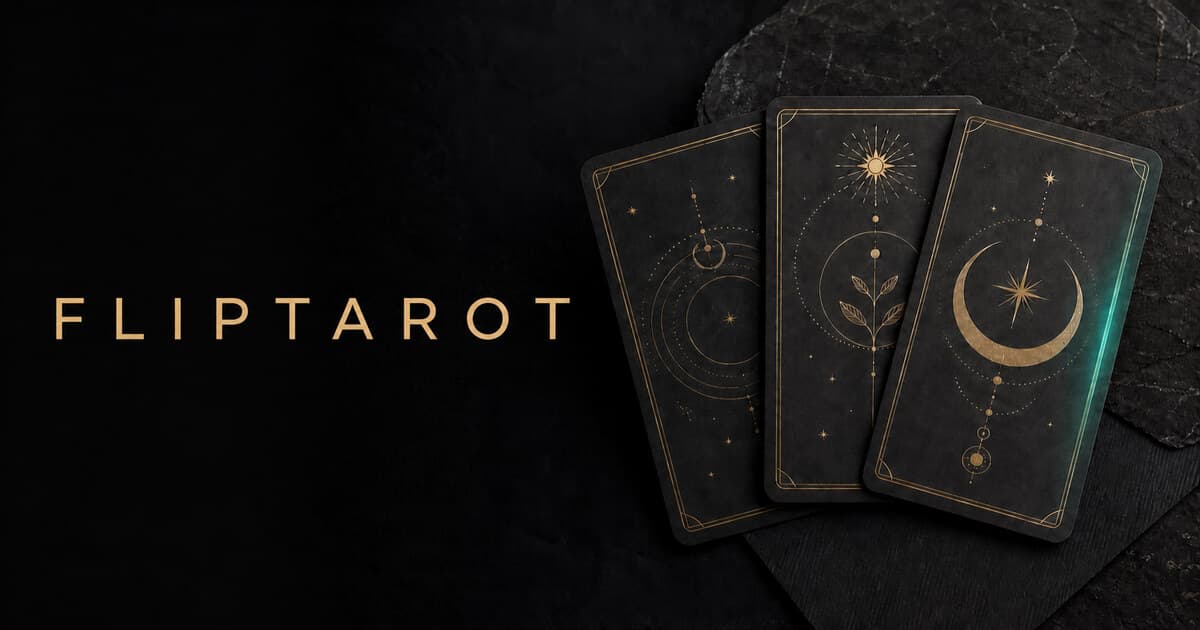
Yes. Online tools offer another way to encounter the cards and experience a reading. On FlipTarot, you can begin with daily guidance or bring a question about a relationship, career, or decision. Its AI interpretations consider the question alongside the cards and their positions in the spread.
Find Your Own Way Into Tarot
Tarot has moved from Renaissance card tables into spiritual practice, artists’ studios, literature, and digital reading experiences. Its history is one of adaptation, with familiar images continually finding new settings and interpretations.
You can begin with whichever part draws your attention: the artwork, the symbols, the stories, or a question you would like to explore.
Get to know the cards through FlipTarot’s tarot card meanings, or try a daily reading to experience how an image becomes part of a reading.